Efficient Picking Cuts Warehouse Costs by 40%!
In the competitive landscape of modern logistics and UK fulfilment, every second counts and every penny matters. The picking process—the act of retrieving items from storage locations to fulfil customer orders—represents one of the most labour-intensive and costly operations in any warehouse environment. Studies consistently show that picking accounts for approximately 55% of total warehouse operating costs, making it the single most significant opportunity for cost reduction and efficiency gains.
Whether you're operating a small e-commerce operation in Manchester, managing a large distribution centre in Birmingham, or running a specialist UK 3PL facility in Leicester like Beckdale Fulfilment, implementing efficient picking strategies can transform your bottom line whilst simultaneously improving customer satisfaction and competitive positioning.
Understanding the True Cost of Inefficient Picking
Before exploring solutions, it's crucial to recognise the hidden costs that inefficient picking processes impose on warehouse operations. The financial impact extends far beyond simple labour hours, creating a ripple effect throughout the entire supply chain.
Labour Costs and Productivity Losses
The most obvious expense relates to labour. When warehouse staff spend excessive time walking between pick locations, searching for products, or correcting errors, productivity plummets and costs soar. Consider these sobering statistics:
- Walking time typically consumes 50-60% of a picker's shift in poorly optimized warehouses
- Search time adds another 15-20% when locations aren't clearly marked or stock isn't properly organized
- Error correction can consume 10-15% of available time when picking accuracy suffers
- This leaves merely 10-20% of time for actual productive picking activity
For a warehouse employing twenty pickers at an average cost of £25,000 annually, improving picking efficiency by just 25% could generate savings exceeding £125,000 per year—a figure that immediately justifies investment in proper systems and training.
Customer Satisfaction and Retention Impact
Beyond direct costs, inefficient picking damages customer relationships through delayed shipments, picking errors, and stockouts. In today's instant-gratification economy, where consumers in London, Leeds, or Glasgow expect next-day delivery as standard, these failures prove particularly costly. Research indicates that 69% of consumers are less likely to shop with a retailer again following a poor delivery experience.
The Foundation of Efficient Picking: Strategic Warehouse Layout
Efficient picking begins long before anyone touches a product. The physical layout and organization of your fulfilment warehouse fundamentally determines picking efficiency.
ABC Analysis and Slotting Optimization
The Pareto Principle applies powerfully to warehouse management: typically, 20% of your SKUs account for 80% of your picks. ABC analysis categorizes inventory based on velocity:
- A-items (high-velocity products) should occupy prime locations closest to packing stations
- B-items (medium-velocity) fill secondary zones with moderate accessibility
- C-items (slow-moving products) can be stored in less accessible areas
This strategic slotting reduces average travel distance per pick by 30-40%, directly translating to faster order processing and reduced labour costs. Businesses handling beauty products or clothing items with distinct seasonal patterns benefit enormously from regular slotting reviews.
Logical Flow and Zone Design
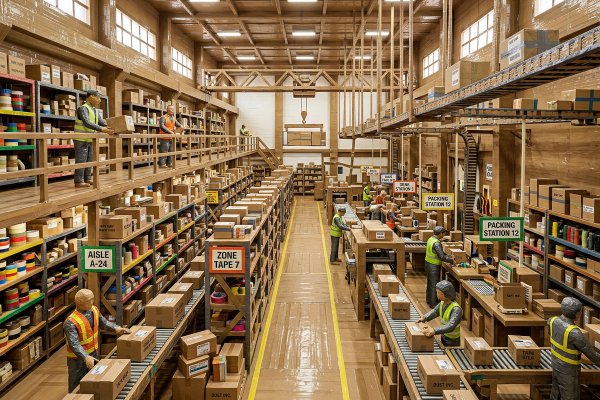
Creating logical picking zones that align with order profiles minimizes congestion and optimizes picker routes. Many successful operations in Bristol, Edinburgh, and Leicester implement zone-based picking strategies where individual pickers become experts in specific product categories, reducing search time and improving accuracy.
WMS Software: The Digital Backbone of Modern Picking
While physical layout provides the foundation, Warehouse Management System (WMS) software delivers the intelligence that transforms good picking operations into exceptional ones. Modern WMS platforms represent the technological leap that separates leading UK 3PL fulfilment providers from their struggling competitors.
Real-Time Inventory Visibility and Control
A robust WMS provides real-time visibility across all inventory locations, eliminating the guesswork and manual searching that plague paper-based or spreadsheet-dependent operations. This stock traceability capability proves particularly critical for businesses handling products with expiry and batch numbers, such as those in the food distribution sector.
Intelligent Pick Path Optimization
Advanced WMS software calculates the most efficient route through the warehouse for each pick list, considering factors such as:
- Physical distance between pick locations
- Product weight and fragility (heavy items picked last, fragile items carefully sequenced)
- Congestion patterns at different times of day
- Individual picker performance profiles and current locations
This optimization typically reduces travel distance by an additional 20-30% beyond basic ABC slotting, with corresponding improvements in orders picked per hour. For operations handling B2B fulfilment with larger order volumes, these gains compound dramatically.
Error Reduction Through Digital Verification
WMS-guided picking using handheld scanners or voice-directed systems virtually eliminates picking errors. Barcode verification ensures the correct product is selected from the correct location in the correct quantity—a critical capability for businesses serving exacting channels like QVC TV shopping or preparing Fulfilled By Amazon (FBA) shipments.
Picking accuracy rates above 99.8% become standard with WMS-guided operations, compared to 95-98% accuracy in manual systems. This improvement saves substantial costs in returns processing, customer service interventions, and brand reputation damage.
Data-Driven Continuous Improvement
Perhaps the most valuable long-term benefit of WMS software lies in the performance data it generates. Detailed analytics reveal productivity trends, bottlenecks, and opportunities for further optimization. Forward-thinking operations use this intelligence to continuously refine their processes, creating a culture of ongoing improvement that compounds efficiency gains year after year.
DPD Integration: Streamlining the Final Mile
Efficient picking doesn't end when products reach the packing station. The connection between warehouse operations and shipping services represents the critical final link in the fulfilment chain, and DPD integration exemplifies how modern carrier connectivity amplifies picking efficiency gains.
Automated Label Generation and Manifesting
Direct integration between WMS software and DPD's systems enables automatic generation of shipping labels immediately upon pick completion. This seamless data flow eliminates manual data entry, reduces errors, and accelerates the transition from picked order to dispatched parcel.
For high-volume operations processing hundreds or thousands of orders daily across Newcastle, Southampton, or Leicester, this automation saves countless hours whilst ensuring customers receive accurate tracking information immediately.
Real-Time Service Selection Optimization
Intelligent DPD integration enables dynamic carrier service selection based on factors such as destination, package dimensions, delivery timeframe requirements, and cost. This ensures that the picking efficiency gains you've achieved aren't squandered through suboptimal shipping decisions.
Enhanced Customer Communication
DPD's renowned customer notification systems—providing precise delivery windows and real-time tracking—build upon your efficient picking foundation to create an exceptional end-to-end customer experience. When customers know exactly when their order will arrive, satisfaction scores climb and support inquiries decline, further reducing your operational costs.
Picking Strategies for Different Business Models
Efficient picking isn't one-size-fits-all. The optimal approach varies based on order profiles, product characteristics, and volume patterns.
Discrete Picking for Low-Volume, High-Value Orders
For operations handling custom sendouts or specialized products, discrete picking (one order at a time) offers simplicity and accountability. While potentially less efficient than batch methods, proper WMS route optimization still delivers substantial improvements over unguided approaches.
Batch Picking for E-Commerce Volume
High-volume e-commerce operations benefit enormously from batch picking, where multiple orders are picked simultaneously and later sorted. This approach particularly suits businesses with overlapping SKUs across many orders, common in sectors like cosmetics, supplements, or accessories. The efficiency gains can reach 200-300% compared to discrete picking for appropriate order profiles.
Wave Picking for Mixed Fulfilment Models
Operations handling both Amazon FBM and direct consumer orders might implement wave picking, where orders are released in coordinated waves based on carrier collection schedules, priority levels, or destination zones. This sophisticated approach maximizes both picking efficiency and shipping cost optimization.
Measuring Success: KPIs That Matter
Implementing efficient picking strategies requires measuring the right metrics to validate improvements and identify remaining opportunities:
- Orders per picker per hour – the primary productivity metric
- Lines picked per hour – useful for operations with varying order sizes
- Picking accuracy rate – typically targeting 99.8%+ with WMS guidance
- Cost per pick – the ultimate efficiency measure combining labour, errors, and overhead
- Average travel distance per pick – indicating slotting and routing effectiveness
Leading UK fulfilment operations benchmark these metrics not just internally but against industry standards, driving continuous competitive improvement.
Implementation Roadmap: From Theory to Practice
Transforming picking efficiency requires a structured approach. Successful implementations typically follow this pathway:
- Baseline assessment – Measure current performance across all key metrics
- Layout optimization – Implement ABC slotting and logical zone design
- WMS implementation – Deploy appropriate technology matched to your scale and complexity
- Carrier integration – Connect systems with DPD and other shipping partners
- Training and adoption – Ensure staff understand new processes and technology
- Continuous refinement – Use data analytics to identify and address remaining inefficiencies
Many businesses, particularly those operating from Leicester, Manchester, or other major logistics hubs, partner with experienced contract packing and fulfilment specialists who have already perfected these systems, accelerating time-to-benefit whilst avoiding costly implementation mistakes.
The Competitive Advantage of Efficient Picking
In an era where Amazon has conditioned consumers to expect next-day or same-day delivery at minimal cost, operational efficiency isn't merely desirable—it's essential for survival. Efficient picking creates a virtuous cycle: reduced costs enable competitive pricing, faster processing enables superior delivery speeds, and higher accuracy boosts customer satisfaction and repeat business.
Whether you're an established retailer re-evaluating your fulfilment strategy, a growing e-commerce business scaling operations, or a brand exploring partnership with a specialist provider like www.beckdaleshipping.co.uk, prioritizing picking efficiency delivers returns that extend far beyond simple cost reduction. It creates the operational foundation for sustainable growth, exceptional customer experiences, and genuine competitive differentiation in increasingly crowded markets.
The question isn't whether to optimize your picking operations—it's how quickly you can implement changes that will slash costs, boost productivity, and position your business for long-term success in the demanding world of modern fulfilment.
For those seeking to understand the financial implications more precisely, exploring detailed pricing examples or using a pricing calculator can illuminate the specific savings efficient picking might generate for your particular operation and order profile.